Releasing Upper Spine Tension: Rou (Kneading) & Tui (Stroking) for Restoring Balance | Dr. Wu Mingjie & Prof. Lowell Seymour
At a Glance
Item Content Topic Releasing accumulated tension along the upper spine (nape and upper back) to help the body return to balance Two core techniques Rou (kneading) and Tui (stroking) Tools of application Rou uses the upper forearm and elbow; Tui uses the whole forearm Main treatment route Tiandong point → Jianjing (GB21, Gallbladder meridian); below T1, T2, T3 → Huatuo Jiaji points → near Gaohuang (BL43, Bladder meridian) Especially relevant for Prolonged desk work, long hours scrolling on phones, repetitive movements, stiff upper back and neck TCM rationale When qi (vital energy) flows smoothly, health is maintained; when qi movement is blocked and stagnant, imbalance arises Aim Release tension in muscles and fascia, promote relaxation, and restore the body's original balance and freedom of movement
I. Why Prolonged Sitting Tightens the Upper Back and Neck
As technology has advanced—with the internet, mobile phones, computers and automated appliances becoming ubiquitous—ordinary people move less and less in daily life. As physical activity decreases, we rely more on our hands and our minds for work.
Many people spend long hours each day sitting at a computer for work, gaming, or scrolling through social media. Without regular movement, and without actively releasing the tension that accumulates—especially tightness in the upper back and neck—this way of life brings physical discomfort, muscular stiffness, and a mounting sense of stress.
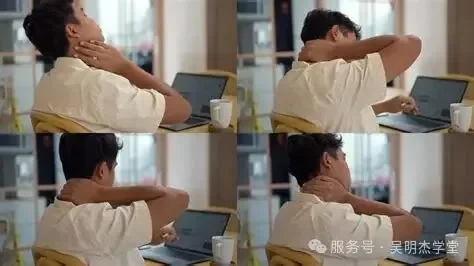
This is why how to release upper spine tension has become such a practical wellness question for sedentary people.
II. Where This Article Comes From: A Record from a Student Who Is Also a Patient
This article aims to share these techniques so that practitioners and patients alike can better sense the body, release tension, and improve overall physical and mental wellbeing.
I am both a student of Dr. Wu and his patient, and what I share here are the methods of treatment I have felt firsthand and the techniques I have learned. The record that follows covers both the treatment route and the bodily sensations involved, offered as a reference for practitioners and for anyone facing the same difficulties.
III. Two Core Techniques for Releasing Upper Spine Tension: Rou and Tui
This protocol is used to soothe tension along the upper spine, and its core consists of two techniques: Rou (kneading) and Tui (stroking).
| Technique | Tool of application | Movement | Treatment route | Shared aim |
|---|---|---|---|---|
| Rou (Kneading) | Upper forearm, elbow | Gentle circular rotations, moving side to side, mobilizing the fascia | Tiandong → Jianjing (GB21); below T1–T3 → Huatuo Jiaji points → near Gaohuang (BL43) | Release tension in muscles and fascia, promote relaxation, and help the body return to its original balance and freedom of movement |
| Tui (Stroking) | The whole forearm | Smooth and continuous, stroking up and down along both sides of the spine | Both sides of the spine, moving upward and downward | Same as above |
3.1 Rou — The Kneading Technique
Rou uses the upper forearm and the elbow as its tools of application. The practitioner works with gentle circular rotations, moving from side to side, to mobilize the fascia in specific areas of the upper spine and neck.
Treatment route:
- Work from the Tiandong point toward Jianjing (GB21) on the Gallbladder meridian, moving the fascia from side to side and kneading in circles;
- Continue kneading along the area below the 1st, 2nd and 3rd thoracic vertebrae (T1, T2, T3), passing through the Huatuo Jiaji points and extending to the vicinity of Gaohuang (BL43) on the Bladder meridian.
Point reference (reading aid)
Point as named in the original Note Tiandong point Retained as named in the original; not renamed Jianjing Gallbladder meridian, GB21 T1 / T2 / T3 1st, 2nd, 3rd thoracic vertebrae Huatuo Jiaji points Extra-meridian points alongside the spine Gaohuang Bladder meridian, BL43
3.2 Tui — The Stroking Technique
Tui uses the whole forearm. The movement is smooth and continuous, stroking up and down along both sides of the spine.
The aim of these techniques: to release tension in the muscles and fascia, promote relaxation, and help the body return to its original balance and freedom of movement.
IV. How Tension, Qi and Health Are Connected
From the perspective of traditional Chinese medicine, the body maintains health through the smooth movement of qi (vital energy). When the flow of qi is obstructed and becomes stagnant, imbalance forms, which in turn affects the state of health throughout the whole body.
Working with the fascia and the surrounding muscles helps ease physical tension, improve comfort, and promote relaxation. These benefits are especially important for people who sit for long periods or repeat the same movements over and over.
The nervous system and the immune system are intricate and deeply interconnected. Applying these techniques consistently can help release tightness and clear obstruction; if such obstruction is left unattended over time, it can interfere with the normal movement of righteous qi (Zheng Qi). What matters is this: before Hashimoto's disease, Parkinson's disease, multiple sclerosis and many autoimmune conditions are diagnosed, maintain the natural state of communication between the nervous and immune systems.
⚠️ Scope of this article: The passage above shares traditional wellness concepts and manual techniques. It does not claim to prevent, diagnose, or treat any of the conditions named. Anyone diagnosed with, or suspected of having, such a condition should continue to follow their specialist's care plan; manual therapy does not replace conventional medical care.
V. Acknowledgement and an Invitation to Practice
My thanks to Dr. Wu for sharing his knowledge, his experience and his techniques.
Living in an age that feels ever more technological, let us not forget the importance of movement, hands-on touch, and caring for the physical body.
Our bodies deserve the same attention and care we give our minds.
Now—let us begin practicing together!
Related Reading
- Huatuo Jiaji Points: Location, Mechanism & Why Daoist Tui Na Values Them
- Fengyang Tui Na (Nine-Line Acupoint Therapy): A 1,700-Year Daoist External Healing System
- Dr. Wu Mingjie: Academic Thought & Clinical Experience in Fengyang Daoist TCM
- Fengyang TCM Case Study: Treatment of Lumbar Lordosis Reversal
Disclaimer: This article is wellness education and a shared study note on manual techniques. It is not a basis for diagnosis or treatment and cannot replace professional medical care. Work on the spine and nape should be performed by a qualified practitioner or under professional guidance. If you experience persistent pain, numbness, limited mobility or other discomfort, please seek medical attention promptly.