Huatuo Jiaji Points: The "Hidden Switches" Along Your Spine—Why Daoist Tui Na Values Them
Keywords: Huatuo Jiaji points, Jiaji acupoints location, Fengyang Daoist Tui Na, spinal adjustment, extra-meridian points, spinal nerves, TCM education Abstract: Huatuo Jiaji points are a row of "extra-meridian acupoints" hidden beside the spine. Lying close to spinal and sympathetic nerves, they serve as a key "pivot" in Daoist manipulative therapy. This article explains their location, the science behind their whole-body effects, how the Fengyang school applies them clinically, and the safety boundaries of spinal manipulation.
When people think of acupuncture points, names like Zusanli (ST-36), Hegu (LI-4), and Yongquan (KI-1) usually come to mind first—the "celebrity points." But there is a row of points tucked alongside the spine that is both uniquely positioned and remarkably useful, yet rarely mentioned by the general public: the Huatuo Jiaji points.
Today, we will skip the mysticism and start with these "hidden switches," then explore how Fengyang Daoist Tui Na views and applies them. This is a science-based primer—clear mechanisms, no exaggeration, no deification.
⚠️ Important warning upfront: The area around the spine is not something you should manipulate on your own. Read to learn, but please do not try this on yourself. I will repeat this point.
1. Where Are the Huatuo Jiaji Points? Meet the "Hidden Switches"
1.1 What Are Huatuo Jiaji Points?
In TCM, Huatuo Jiaji points belong to the category of "extra-meridian points" (Jingwai Qixue). In plain terms, they do not sit on the main pathways of the Twelve Regular Meridians or the Ren and Du vessels. They are a row of empirically discovered points summarized by ancient clinicians over generations of practice.
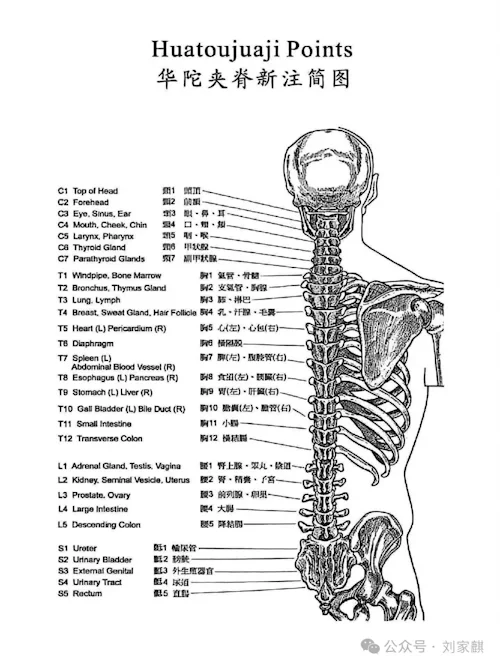
1.2 Precise Location of Jiaji Points
They are easy to orient once you know the landmarks:
| Parameter | Detail |
|---|---|
| Region | Back and lumbar region |
| Range | From the 1st Thoracic Vertebra (T1) down to the 5th Lumbar Vertebra (L5) |
| Method | Below each spinous process, approximately 0.5 cun bilateral to the spinal midline |
| Total count | 17 points per side → 34 points total |
The name "Huatuo" is traditionally associated with the legendary physician Hua Tuo of the Eastern Han/Three Kingdoms era, and folk tradition regards these points as one of his valuable clinical legacies.
1.3 Why They Are Special
What makes this row remarkable is its immediate proximity to the spine—the body's central axis. The spine connects the brain above, reaches the limbs below, and along the way carries the neural pathways that regulate every internal organ. Location determines function, which brings us to the next question: why can one row of points influence the whole body?
2. Why Can Jiaji Points Influence the Whole Body? Mechanism Explained
Many people wonder: if Jiaji points just sit next to the spine, why do they seem to "reach" so many different areas?
2.1 A Real-World Analogy
Think of the spine as the main cable of a high-rise building, running from the top floor all the way down to the basement. At every floor it branches out to control the lights, air conditioning, and appliances of that level. The Jiaji points sit exactly at the location of these branch access panels—the inspection hatches where each segment's wiring can be reached.
2.2 The Modern Medical Perspective: Spinal Nerves & Sympathetic Chain
From a modern anatomical standpoint, the subcutaneous and deep tissues around Jiaji points are precisely where spinal nerves exit and where the sympathetic nerve chain runs:
| Structure | Function |
|---|---|
| Spinal nerves | Control muscle movement and sensation in their corresponding segments |
| Sympathetic chain | Participates in the regulation of visceral (organ) functions |
Therefore, stimulating a Jiaji point at a given segment can, in theory, influence the muscles and visceral functions governed by that segment:
- Thoracic-level Jiaji → more closely associated with thoracic and abdominal organ function
- Lumbar-level Jiaji → more deeply connected to the lower limbs and pelvic region
This is the mechanistic foundation for the principle that "one point can regulate many areas"—and one of the explanations behind the TCM concept of "spine-related" therapy.
2.3 A Science-Based Disclaimer
Let me be clear: this is a mechanistic explanation at the popular-science level, not a guarantee and certainly not a claim that it cures all diseases. Jiaji points excel at regulation and adjunctive care; whether they work for a given individual, and how to apply them, must be determined through proper pattern differentiation (bianzheng).
3. How the Fengyang Daoist School Uses Jiaji Points
When it comes to a tradition that has taken the Jiaji concept to its fullest expression, the Fengyang Daoist Tui Na school stands out.
3.1 Jiaji as the "Pivot"
Fengyang Daoist Tui Na follows a distinctive holistic framework:
- It regards Jiaji points as the "pivot" (shu ji) of regulation—the critical leverage point
- It emphasizes a holistic view, explicitly rejecting the "treat the head for a headache, treat the foot for a footache" approach
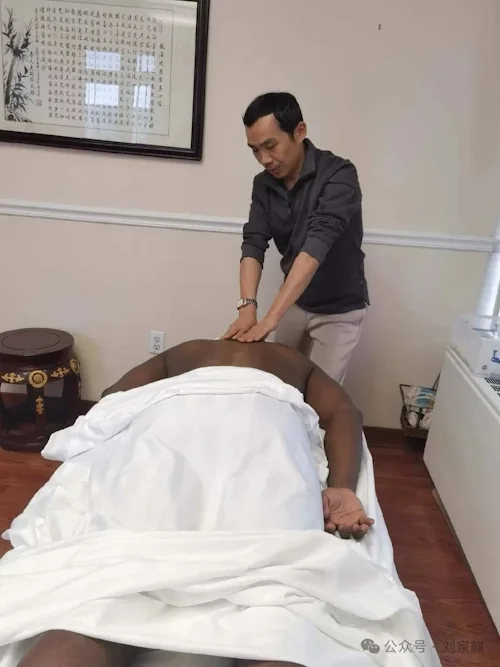
For example, a patient with recurrent stomach discomfort would not be treated by focusing only on the abdomen. Instead, the practitioner examines the thoracic Jiaji points and related spinal segments, viewing the entire body's imbalance through the lens of the spinal axis.
3.2 "Dual Cultivation of Medicine and Dao": Tui Na + Dao Yin + Mind Training
The Fengyang school also emphasizes "dual cultivation of medicine and Dao"—beyond manual techniques, it incorporates Dao Yin (guided movement) and health-preservation mind methods, treating the body and mind as an integrated whole.
It places strong emphasis on pattern differentiation, and its techniques are characterized by a refined sense of rhythm, pressure modulation, and timing—not "the harder the better."
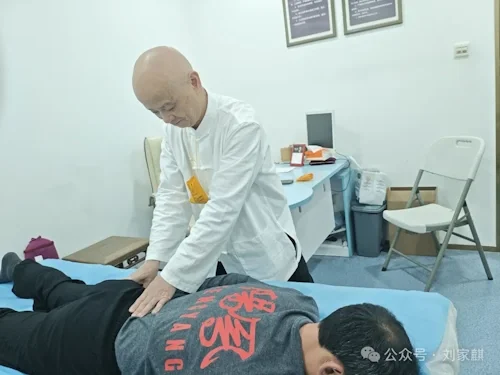
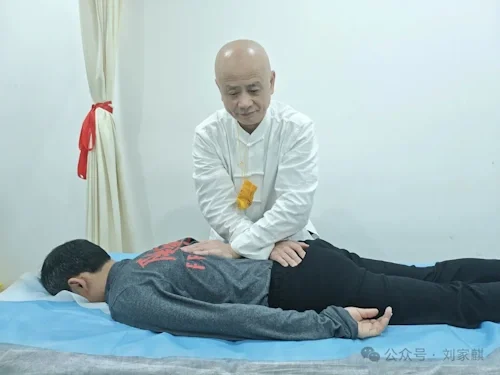
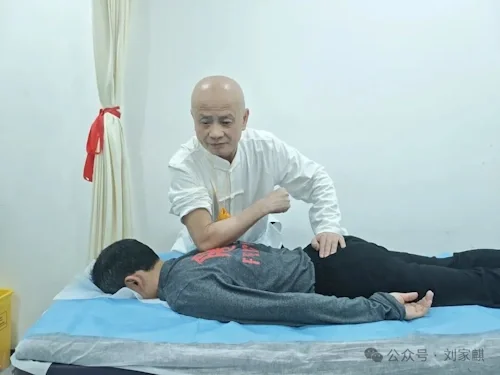
3.3 Wu Mingjie and the Fengyang Lineage
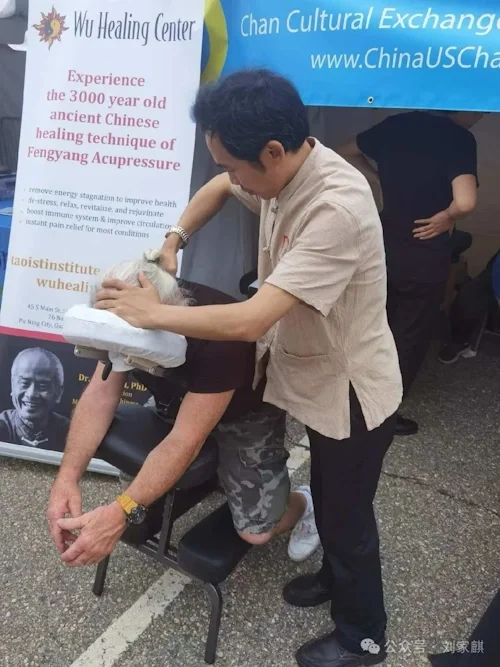
Mr. Wu Mingjie is one of the representative inheritors of the Fengyang Daoist Tui Na tradition. Within his lineage, this art has been passed down generation to generation and grounded in clinical practice. As TCM practitioners, we hold such teacher-to-student lineages in deep respect.
3.4 Safety Boundary: Do Not Self-Study
One boundary I must draw clearly: the specific techniques, point selection, and rhythmic protocols of the Fengyang school belong to a closed teacher-student transmission system. Non-professionals should not attempt to learn or imitate them independently.
And I must repeat this emphatically: manipulation near the spine carries real risk. No matter how curious you are, never try to imitate it yourself—and absolutely do not attempt to "crack your own neck, wrench your own back, or twist your own spine." Always go to a proper accredited medical institution and seek a qualified TCM physician. This is a non-negotiable safety bottom line.
4. A Doctor's Honest Words: Points Are Tools—It Depends on the User
As physicians, we in TCM often say:
> "Acupoints are tools. What matters is how they are used—and on whom."
I tell my patients all the time: do not assume something is mystical just because it is called "ancestral technique," and do not assume spinal manipulation is harmless just because it is called "massage."
The spine is the body's load-bearing axis and a critical neural corridor. An error of even a millimeter near it can mean real danger. That is why I hold to one principle:
- ✅ Popular science can explain mechanisms and thought processes
- ❌ But when it comes to your own body, always leave it to the professionals
The more you understand, the clearer your boundaries become; the clearer your boundaries, the less likely you are to be misled by exaggerated claims. That is the whole point of why I do this kind of education.
5. Closing Thoughts
Today we started with the "hidden switches" of the Huatuo Jiaji points and covered:
- ✅ Their location—along both sides of the spine, from T1 to L5, 17 per side
- ✅ The mechanism behind their whole-body effects—spinal nerves + sympathetic chain
- ✅ The Fengyang Daoist school's approach of "Jiaji as pivot, holism first, medicine-Dao dual cultivation"
- ✅ The safety bottom line for spinal manipulation—leave it to qualified professionals
⚠️ > One last reminder:> The above content is for > health education only> . Any Jiaji-point or spine-related regulation must be performed in a > proper medical institution> by a > qualified physician> . Readers must not attempt self-application.
Let's Talk
Have you ever had Tui Na? Ever been "cracked" by an adjustment? How did it feel? Share your experience in the comments below.
Support & Follow
If today's article helped you, here are three quick things you can do:
- Hit "Follow" and add [Dr. Liu's TCM Education] to your regular reading list—be the first to get updates.
- Give it a "Like" or "Share" so more people who care about spinal health can see it.
- Leave your story or question in the comments—Dr. Liu will reply to representative ones.
> Dr. Liu's TCM Education—reliable TCM information only. Please share with those you care about.
⚕️ Medical Disclaimer
The content of this article is for health education purposes only and cannot replace the diagnosis and treatment of a qualified physician. Spinal manipulation and adjustment carry inherent risks. Please always visit a properly accredited medical institution and seek care from a qualified TCM practitioner. Do not attempt self-manipulation, and especially never try to "crack your own neck, wrench your own back, or twist your own spine." Acupoint regulation and manipulative techniques are not a cure-all; individual conditions vary. If you feel unwell, please seek medical attention promptly.
📌 Related Reading (Internal Link Suggestions)
About the author
Liu Jiaqi, Chief Physician, Colorectal & Anal Surgery, Beihai People's Hospital; disciple of Dr. Wu Mingjie (Fengyang lineage); specialist in integrated Chinese-Western medicine; fourth-generation inheritor of TCM Grand Master Deng Tietao.