Pressing Bailao Point: A Home Practice for Chronic Cough & Asthma Relief
Does this sound familiar? You cough every time the season changes. Dry nighttime coughing keeps you awake. A slight breeze leaves you short of breath and tight in the chest. Millions struggle with chronic cough and recurrent asthma—long-term medications bring slow relief, and symptoms bounce back the moment treatment stops.
In Traditional Chinese Medicine (TCM), there is an extra-meridian point called Bailao (颈百劳, EX-HN15)—a time-honored acupoint specifically targeting chronic cough, deficiency-type wheezing, and lung qi weakness .
Its greatest advantage? It is safe, zero-cost, non-invasive, and entirely self-administered at home. No equipment, no herbs—just consistent daily acupressure to gently regulate lung qi, relax bronchial tension, and support steady recovery from chronic respiratory complaints.
I. Why Does Bailao Point Work for Chronic Cough & Asthma?
Bailao—literally "Hundred Labors"—earned its name because it addresses a wide spectrum of deficiency-induced ailments, with a particular affinity for lung-deficiency patterns and chronic cough .
TCM understands chronic cough and stubborn asthma not merely as lung inflammation, but as a deeper imbalance:

Chronic sleep deprivation, prolonged stress, and underlying weakness eventually deplete lung qi, causing the airways to become hyper-reactive and spasm frequently—creating a self-perpetuating cycle of cough and wheeze.
Bailao Point sits adjacent to the upper trajectory of the Lung Meridian and the cervical qi-flow 枢纽 (pivot). Its two core actions:
Nourish Lung Yin & Disperse Lung Qi — Specifically improves post-viral lingering cough, dry nighttime cough, and deficiency-type wheezing.
Soothe Tendons & Unblock Collaterals; Calm Wheezing — Relieves bronchial spasm, reduces chest tightness, shortness of breath, and wheezing.
Unlike temporary cough suppressants that merely "turn off" the symptom, Bailao acupressure is root-focused tonification—replenishing chronically depleted lung qi, lowering airway reactivity, and reducing recurrence at the source.
Additionally, Bailao relaxes the neck-shoulder sinew network. Many cough/asthma sufferers also present with stiff necks and impaired qi ascent; unblocking Bailao restores head-neck microcirculation and supports smooth pulmonary qi flow .
II. Precise Location of Bailao Point (Easy for Anyone to Find)
Standard Anatomical Location
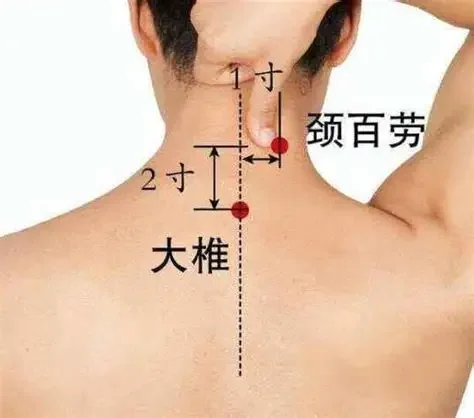
Bailao (EX-HN15), an extra-meridian acupoint, is located on the nape, 2 cun directly above the lower border of the spinous process of the 7th cervical vertebra (C7), 1 cun lateral to the posterior midline—one point on each side .
Simple 3-Step Home Location Method
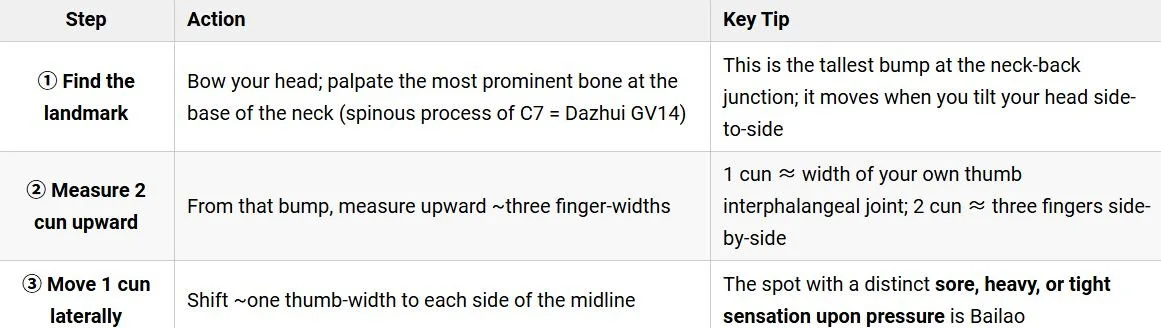
💡 Tip: Sitting upright with the head slightly flexed (or prone position) relaxes the musculature and makes the soreness more pronounced. You can reach and press both points with your own thumbs—anytime, anywhere.
III. Standard Home Acupressure Protocol
For chronic cough and asthma, we recommend a gentle technique—non-irritating, qi-preserving, suitable for all ages.
Step-by-Step Protocol
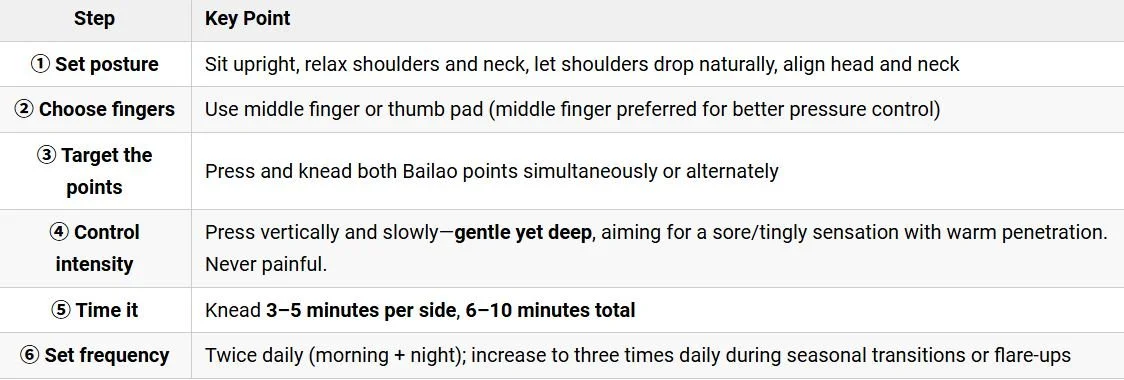
⚠️ Critical warning: Never jab, pinch hard, or "go for the pain." The posterior neck houses dense neurovascular structures. The correct sensation is "sore but comfortable"—more pain does NOT mean more effect.
Tailored Timing for Specific Symptoms

With consistent practice, you may see marked improvement in: stubborn chronic cough, seasonal allergic cough, asthma-related shortness of breath, shallow breathing, deficiency-type night sweats, and recurrent itchy throat.
IV. Golden Combinations: Double the Effect
Bailao works well alone, but pairing it with adjacent points significantly amplifies results :
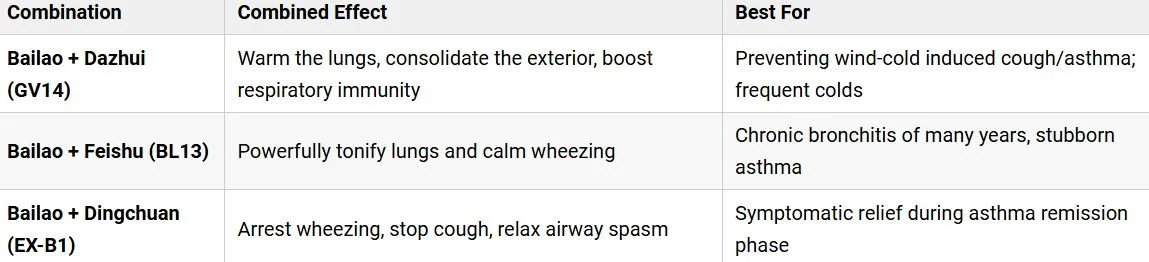
Dazhui (GV14) sits right in the depression below the C7 spinous process—you already touch it while locating Bailao, making combination pressing very convenient.
V. Who Can Benefit?
✅ Year-round chronic dry cough, persistent cough, post-cold lingering cough;
✅ Allergic asthma, seasonal cough/wheeze, nighttime chest tightness and shortness of breath;
✅ General weakness, cough/wheeze triggered by mild exertion, low immunity;
✅ Desk-bound individuals with stiff neck/shoulders, restricted breathing, and a sense of chest oppression.
VI. Safety Precautions & Contraindications
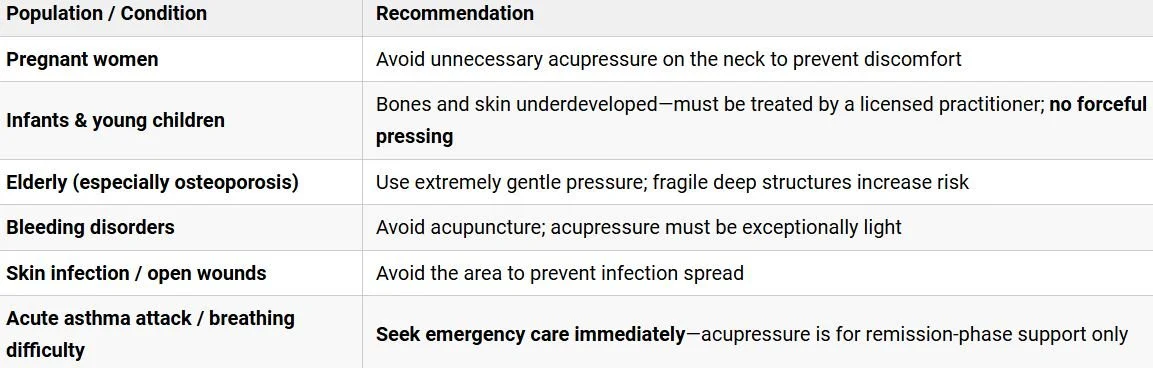
⚠️ Anatomical caution: Bailao lies in the upper posterior neck, near the occipital and vertebral arteries/veins and branches of the greater/lesser occipital nerves [citation:6]. While not classified as a "dangerous point," practitioners must avoid deep or angled pressure that could impinge on these structures.
VII. A Parting Note on Wellness
TCM wellness is guided by the principle: "Seven parts nourishment, three parts treatment" (七分养,三分治). The hardest part of chronic respiratory issues is not the temporary relief—it is strengthening the root to prevent recurrence.
As a non-invasive, gentle, self-healing practice, Bailao acupressure does not rely on medication. Through daily meridian activation, it replenishes lung qi, unblocks qi flow, soothes airway hypersensitivity, and allows the weakened respiratory system to gradually regain its self-regulating capacity.
As recorded in Zhenjiu Zisheng Jing (《针灸资生经》), Bailao has treated deficiency-labor disorders for centuries. This long clinical legacy is the strongest testament to its value.
Press gently, nourish patiently, and improve gradually. With consistent practice, you can break free from the cycle of recurrent cough and wheezing—achieving a 温和 (gentle), stable, and lasting respiratory recovery.
Related Reading
Huatuo Jiaji Points: Why Daoist Tui Na Values This "Hidden Switch"
Guchi Shenfang: Qing Dynasty Herbal Tooth Powder for Gums & Toothache
Disclaimer: This article is for TCM wellness education and home self-care guidance only. It does not replace professional medical diagnosis or treatment. Patients with asthma or chronic lung disease should follow their physician's treatment plan; acupressure serves only as a complementary supportive practice. If you experience difficulty breathing, hemoptysis (coughing up blood), or persistent fever, seek immediate medical attention.
Produced by the Wu Mingjie TCM Team · Fengyang Daoist TCM. Please credit the source when sharing.