
Chen Dong: The Guangdong Wisdom of "Tea for Harmony Under Heaven" Begins a New Chapter
An exclusive interview with Chen Dong, President of the Guangdong Tea Collection and Appreciation Association
"Let's have tea when we're free" (de xian yin cha) is a life philosophy etched into the bones of the Guangdong people. Grain Rain has just passed; late spring turns to early summer—a fine time for drinking tea.
Was the earliest Chinese tea recorded in history from Guangdong? How did tea conquer the globe through the "Maritime Silk Road"? How will Guangdong tea embrace new space for future development? Yangcheng Evening News interviews Chen Dong, President of the Guangdong Tea Collection and Appreciation Association, to hear him tell the Guangdong wisdom of "tea for harmony under heaven."
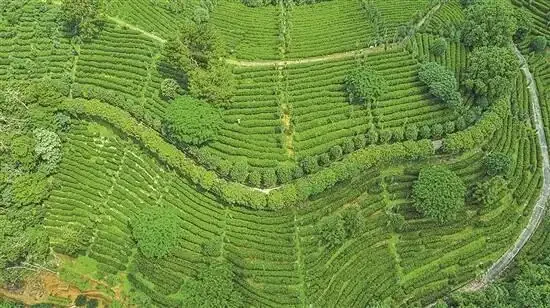
The Earliest Gaolu Tea Came From Guangdong
Yangcheng Evening News: We often say "tea grows in the south." What position does Guangdong occupy among the origin regions of the tea plant?
Chen Dong: The world's tea plants originated in southern China. The surviving ancient tea trees over a thousand years old that have been documented so far are mainly distributed across the Yunnan-Guizhou Plateau. But Guangdong also has ancient tea trees of seven to eight hundred years and above—for example, the "Song-era" (Songzhong) ancient tea tree community of Phoenix Dancong, over 760 years old. In northern Guangdong there are also Qinggui large-leaf varieties over 500 years old (including Luokeng large-leaf and Liannan large-leaf).
Guangdong is one of the important origin regions of the tea plant in China. Of the 18 species and varieties of tea-family plants nationwide, Guangdong has 4—second only to Yunnan, Guizhou and Guangxi in number.
The earliest "tea" recorded in human writing was named Gaolu tea. According to the Eastern Jin scholar Pei Yuan's Records of Guangzhou (Guangzhou Ji): "Xiping County (west of today's Huiyang County, Guangdong) produces Gaolu, another name for tea (ming); the leaves are large and astringent, and southerners use it as a drink." Gaolu tea was once regarded as the ancestor of the world's tea and drew the attention of scientists worldwide. In 1985, Professor Chen Xingyan of Hunan Agricultural College and others verified that the earliest Gaolu tea was indeed produced in Guangdong, distributed from Heyuan to the Xiqiao Mountain area. However, this plant is not true tea, but a large-leaf holly plant—commonly known as bitter-ting tea (kuding cha).
In addition, Guangdong was already one of China's eight major tea-producing regions before the mid-Tang dynasty. Among the eight tea-producing districts recorded in Lu Yu's The Classic of Tea (Cha Jing), the Lingnan Circuit was a famous one.
Yangcheng Evening News: In recent years Guangdong tea has had many shining moments. When the leaders of China and France held their tea gathering at Songyuan in Guangzhou, the table featured Yingde black tea and Chaozhou Dancong. Why can they represent Guangdong?
Chen Dong: Actually, Guangdong's famous teas fall into four major categories: the first is Yingde black tea, whose core production area is in Yingde City, Qingyuan; the second is Phoenix Dancong tea, whose core production area is in Chaozhou City; the third is Hakka roasted green tea, whose cultural origins can be traced back to the Wei, Jin and Northern and Southern Dynasties, and which is hailed as an important "living fossil" of Han tea culture; the fourth is Qingxiang (light-fragrance) oolong, which earliest originated in the Shiguping oolong on Phoenix Mountain in Chaozhou and the Xiyan oolong at the border of Dabu and Raoping, and is now mainly produced in Zhanjiang and Heyuan.
According to the Chaozhou Prefecture Gazetteer, Phoenix Dancong tea can be traced back to the late Southern Song dynasty, with a history of over 700 years. Chaozhou preserves more than 3,700 ancient tea trees over 200 years old, among which 3 "Song tea" trees are over 760 years old. Phoenix Dancong's flavor types are extremely rich; it is commonly credited with "ten great fragrance types," though in fact there are far more than that.
The eight characters "perfume among teas, harmonious fragrance" precisely capture the quality character of Phoenix Dancong, making it the most recognizable fine tea in consumers' first impression.
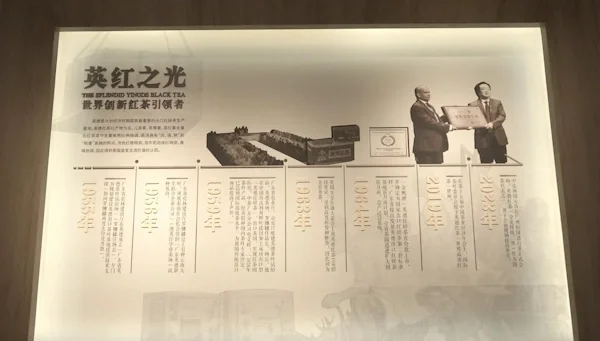
Yingde black tea, meanwhile, is known for its unique autumn aroma: the floral fragrance special to autumn, complemented by the clean sweetness of sugarcane water. In 1963, Yingde black tea was adopted by the British Queen for royal use, becoming a premium black tea with which the British royal family hosted international guests. Since then it has maintained an annual export scale of five thousand to ten thousand tons, with broad global influence. In October 2019, at the 15th China Tea Industry Economic Annual Conference, the International Tea Committee formally awarded Yingde black tea the plaque "World High-Aroma Black Tea."
From Tea Merchant Capital to a "New-Style Tea" Hub
Yangcheng Evening News: In the process of Chinese tea going out into the world, what role did Guangdong play?
Chen Dong: Chinese tea spread outward along many paths. Before the Tang dynasty, it was mainly overland—the ancient Silk Road opened up by Zhang Qian. Another was the Ten-Thousand-Li Tea Road leading to Russia: from the late 17th to the early 20th century, tea set out from Hunan and the Wuyi Mountains, passed through Hubei, Inner Mongolia and Kyakhta in Outer Mongolia into Russia, then extended to the Middle East, and was transshipped to European countries by the Persian Empire.
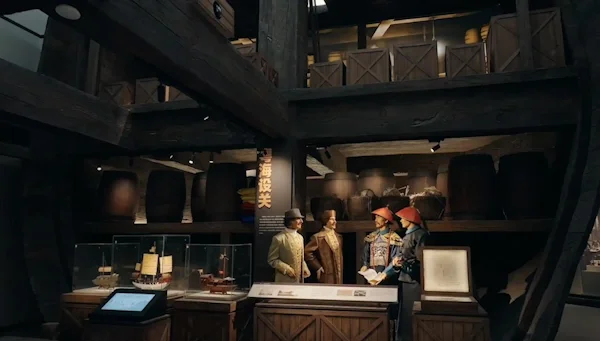
After the Tang dynasty, the maritime route gradually became dominant, and tea went out into the world mainly through the Maritime Silk Road. Guangzhou had been an important tea export port on this route since the Tang dynasty. Especially after Zheng He's voyages to the Western Seas in the Ming dynasty, tea from all over the country crossed mountains and ridges to gather in Guangzhou, was traded through the Thirteen Hongs, and then shipped out from Huangpu Port.
From the Ming dynasty onward, Guangzhou implemented "single-port trade" (yikou tongshang) three times, monopolizing the nation's tea and other goods exports for a cumulative 159 years, thereby establishing Guangzhou's historical status as an international tea merchant capital.
On the fourth floor of the Guangzhou Tea Museum exhibition hall, a ship model reproduced at 1:1 scale recreates the scene of the 18th-century Swedish East India Company ship "Gothenburg" arriving in Guangzhou to load cargo. The hull structure shows that heavy goods were placed at the bottom of the hold as ballast, porcelain or tea wares were stored in the middle, tea was mainly loaded on the upper level, and silk was placed at the very top.
In the 17th and 18th centuries, Chinese tea, ceramics, silk and furniture were luxury goods to Europeans. As long as these goods—especially tea—could be successfully shipped back to Europe for sale, one could obtain "huge profits at minimal cost" (yi ben wan li).
Yangcheng Evening News: Today Guangdong is the birthplace and cluster area of new-style tea drinks. How will Guangdong's tea industry embrace the future?
Chen Dong: New-style tea drinks are the main engine for the future development of China's tea industry. If we don't study the demand that new-style tea places on the raw tea supply chain, we will face sales difficulties.
New-style tea drinks are the best vehicle for Chinese tea culture to go out into the world and be accepted by more countries and peoples of different ethnicities; their communication effect surpasses that of pure tea drinks. Today the pure tea drink market has reached close to 400 billion yuan in scale, basically saturated, lacking new room for growth.
The market space for new-style tea drinks was previously estimated at 500 billion yuan; now it looks likely to reach 800 billion to 1 trillion yuan, including overseas markets. I believe that in the next five years, China will develop 500,000 new-style tea shops domestically, and another 500,000 overseas—1 million in total. By then, the consumption of raw tea for new-style tea will increase from the current 300,000 tons to 800,000 tons, or even 1 million tons.
The second growth space lies in deep processing: by turning tea "waste into treasure," extracting health-beneficial components such as tea polyphenols, theanine and tea polysaccharides, to serve as industrial raw materials or be added to cosmetics, daily necessities, fragrances, food and beverages. This market is currently about 100 billion yuan, and is expected to exceed 300 billion yuan in the future.
To embrace both the new-style tea and deep processing markets, we must carry out comprehensive transformation and upgrading in our production system, industrial capacity, product R&D and marketing capability.
I suggest that Guangdong concentrate all the funds and policies supporting the tea industry, as well as the manpower and material resources guiding tea enterprises and tea farmers in technical improvement, into each main tea-producing area, focusing on one key producing county, and run well at least one tea refining factory with an annual production capacity of between 5,000 and 20,000 tons. This refining factory would connect with the existing hundreds of small and medium primary tea processing factories and tea farmers, centrally processing the primary tea from each household and unifying it into standardized refined tea, so as to meet the procurement needs of new-style tea and deep processing enterprises.
The Essence of Chinese Tea Culture: Tea for Harmony Under Heaven
Yangcheng Evening News: What is it that Chinese people are really drinking when they drink tea?
Chen Dong: Drinking tea is essentially a beautiful way of life. People of different aesthetic cultivation differ in their attitude toward tea, their methods, settings and experiences.
According to legend, tea was first discovered by Shennong, with detoxifying effects. After a considerable period of medicinal practice, people found that long-term tea drinking greatly benefited body and mind, and gradually could not do without it. Tea thus shifted from medicinal use to drinking, becoming an important beverage in the daily life of the Chinese nation, used to quench thirst, refresh the mind and maintain health.
Then came the third stage, when tea gradually entered the world of the literati, the cultural sphere and the arts, and its nature changed accordingly—from the "tea of daily life" in "firewood, rice, oil, salt, sauce, vinegar, tea," it evolved into the "tea of art" in the Tang and Song phrase "zither, chess, calligraphy, painting, poetry, wine, tea," achieving a cultural sublimation.
Today, milk tea, fruit tea, herbal tea and other new-style tea drinks are flourishing. They are all based on tea, and the applications of tea are becoming increasingly broad, with personalization increasingly strong; (the combination of tea with a variety of raw and auxiliary ingredients) is "tea harmonizing with all things."
The reason Guangdong has been able to become the country's largest tea-consuming province is closely related to its deep tea-drinking culture. Guangzhou's teahouse culture is especially worth noting. From the earliest simple tea sheds to indoor tea-drinking venues, people went from drinking tea barefoot to discussing business, deliberating affairs and gathering with friends in professional tea rooms; teahouses gradually became multi-functional spaces for social interaction. Time-honored teahouses such as Lin Heung Lau and Tao Tao Ju have been passed down to this day, profoundly influencing Guangzhou people's tea consumption and cultural exchange.
One person drinking tea is harmony (heqi)—calming the heart and settling the spirit; a family drinking tea together is concord (hemu)—when the family is harmonious, all affairs prosper; a nation drinking tea is harmony (hexie); when people all over the world drink tea, that is peace. This is the essence of Chinese tea culture: "tea for harmony under heaven."
Text and video | Journalists Zhou Xinyi, Zhu Shaojie
(Some materials provided by the Guangzhou Tea Museum)
Original work of Yangcheng Evening News · Yangchengpai; reproduction without authorization is prohibited.