Bai Snake Root: Green Olive Root for Dampness & Joint Pain
1. Identifying the Herb: "Snake-Skin" Bark Gives It Its Name
In the Chaoshan countryside, elders rarely call this herb by its formal name. They call it "Bai Snake Root" (白蛇根).
This is the dried root of the green olive tree (Canarium album Lour. Raeusch.), a Burseraceae family tree native to Lingnan (southern China). The root's outer bark is pale gray-white with winding longitudinal fissures that strikingly resemble snake skin—hence the vivid folk name "White Snake Root." The name is both descriptive and symbolic, hinting at the herb's traditional role in "expelling wind" (often visualized as snake-like pathogenic qi in TCM theory).
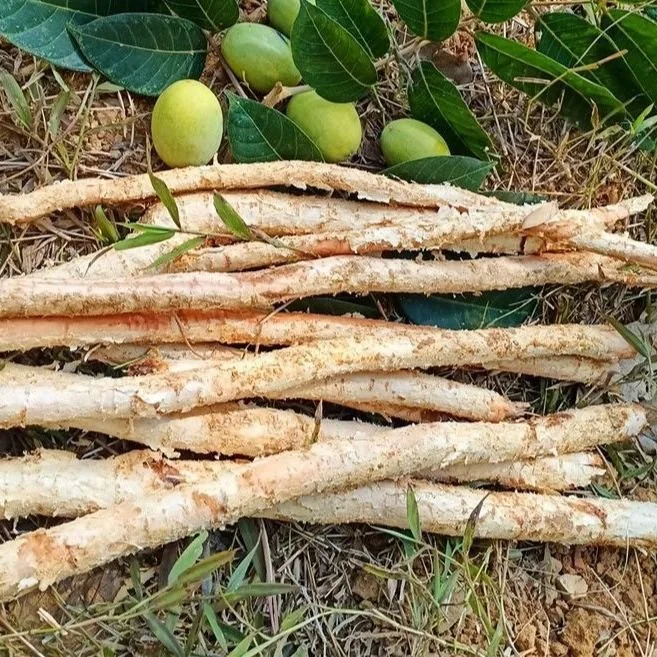
📜 Classical Records: The herb (listed as Bai Lan Gen 白榄根) was first documented in Xiao Budan's Lingnan Materia Medica (岭南采药录), which states it "treats beriberi (foot qi) and cloudy urine (bai zhuo)." Later texts expanded its indications: Quanzhou Materia Medica notes it "treats arthralgia from wind-dampness"; the National Compilation of Chinese Herbal Medicines summarizes: "Relaxes tendons and activates collaterals, dispels wind and dampness—treats wind-damp lower back and leg soreness, postpartum wind paralysis, numbness of hands and feet".
2. Herb Profile: Slightly Bitter, Neutral in Nature
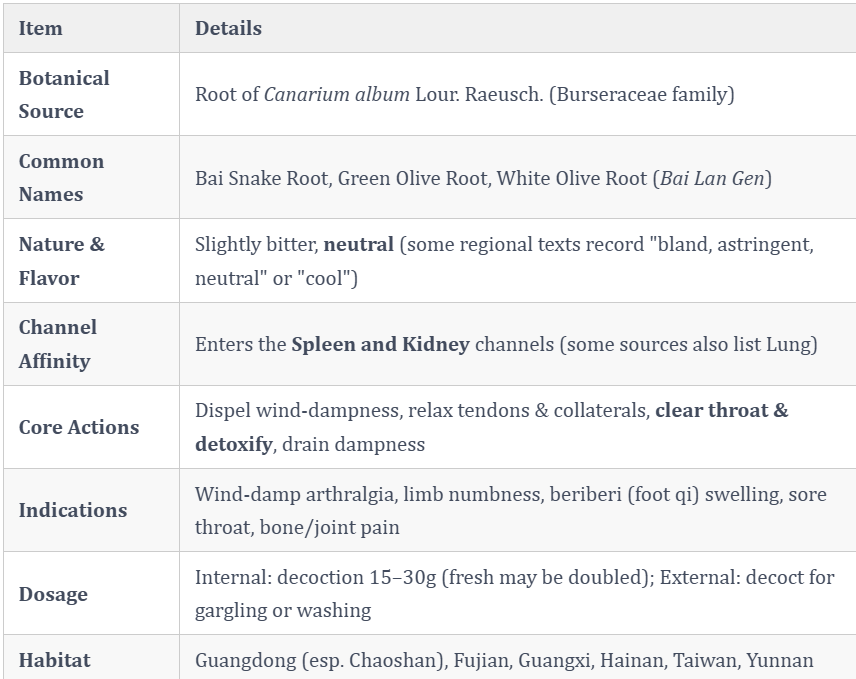
⚠️ Note: Texts differ on whether the root is "neutral" or "cool/cold." Always follow a qualified TCM practitioner's pattern differentiation—do not self-prescribe.
3. Three Core TCM Actions (with Mechanism & Classic Recipes)
✅ 1. Dispel Wind-Dampness & Relax Tendons — The Go-To for Damp, Stiff Joints
This is Bai Snake Root's most celebrated virtue.
The Chaoshan region sits in Lingnan—hot, rainy, and damp. Wind-dampness accumulates in the body, producing the classic complaints: lower back and knee soreness, joint stiffness, numbness in hands and feet, and that "heavy, leaden" feeling in the legs on humid days. Bai Snake Root works by driving out wind-damp pathogens from the channels and relaxing contracted sinews, directly addressing these patterns.
🍲 Classic Recipe 1: Olive Root & Pig Trotter Stew > Source: Lingnan Materia Medica (岭南采药录) > Ingredients: Dried Bai Lan Gen 60–90g (approx. 2–3 liang), 1 pig trotter. Method: Rinse and cut the root into sections. Place with the trotter in a clay pot, add water to cover, bring to a boil, then simmer on low heat for 1.5–2 hours until the meat is tender and the broth is clear-sweet. Season with salt. Action: Dispels wind-dampness, relaxes tendons and collaterals. Traditionally used for beriberi edema and wind-damp lower back/leg soreness.
🍲 Classic Recipe 2: Fresh Olive Root Stewed with Yellow Wine > Source: Fujian Practical Folk Herbs > Ingredients: Fresh olive root 120g (approx. 4 liang), yellow rice wine 120ml (approx. 4 liang). Method: Rinse the fresh root, combine with wine and a little water in a steaming pot, and double-boil (隔水炖) until warmed through. Action: Warms and unblocks the channels, activates blood and relieves pain. Used for bone/joint soreness and postpartum wind paralysis.
💡 Lighter Everyday Version: Short on time? Use Bai Lan Gen 30g + 1 pig tail to make a simpler soup—same dampness-dispelling benefit, easier for a small household.
✅ 2. Clear Throat & Detoxify — A Gargle Remedy for Sore Throat
Bai Snake Root's ability to clear the throat and resolve toxicity makes it a folk standby for swollen, painful throat and dryness.
🌿 Gargle Method: Take 15–30g dried root, decoct in water for 15–20 minutes, let cool to warm, and gargle 4–6 times daily. Classical Basis: Fujian Practical Folk Herbs records: "For unilateral or bilateral tonsillitis (乳蛾), take fresh olive root 120g and 1 small cup of rice vinegar, decoct and gargle 5–6 times daily."
🍲 Beverage Twist: Pair olive root with green olives and reed rhizome (Lu Gen) for a light tea that soothes autumn/winter dry throat and mild throat irritation.
✅ 3. Clear Heat & Drain Dampness — For "Foot Qi" and That Heavy-Body Feeling
The Lingnan Materia Medica explicitly lists Bai Lan Gen for "beriberi (foot qi) and cloudy urine (bai zhuo)." In TCM, "foot qi" here refers to damp-heat pouring downward—swollen lower legs, heavy aching knees, and general lassitude. Bai Snake Root addresses this through fortifying the spleen to drain dampness and relaxing tendons to restore free flow.
4. Modern Research Hints (Informational Only)
Scientific study of olive root is still emerging. Preliminary findings suggest the root contains polyphenols, flavonoids, and tannins with:
Anti-inflammatory and antioxidant effects (in vitro);
Antibacterial activity against certain pathogens (e.g., Staphylococcus aureus);
Possible adjunctive blood-pressure modulation (animal/in vitro studies).
🔬 Important caveat: These are mostly in vitro or animal studies with no high-quality human clinical evidence yet. They do not replace standard medical care. See a doctor for any diagnosed condition.
5. Safety & Contraindications
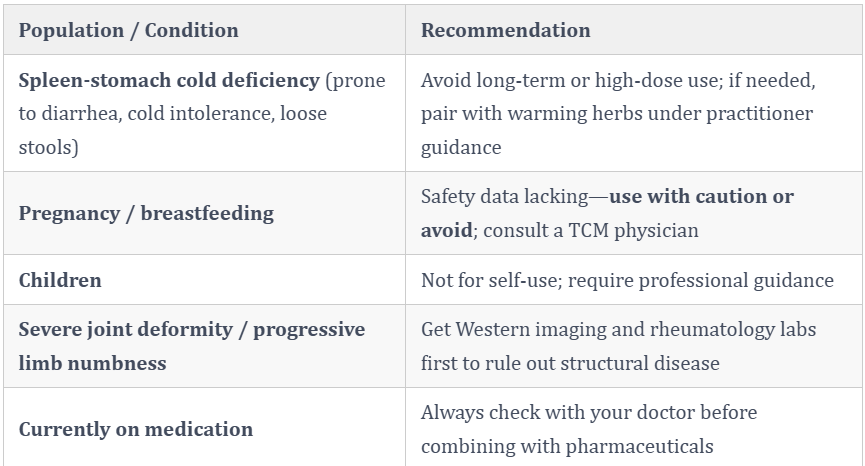
🚫 Three "Don'ts":
Don't use as a substitute for proper diagnosis and treatment;
Don't take long-term or in high doses on your own;
Don't casually combine with strong warming-tonifying herbs (e.g., ginseng, astragalus), which may create counteractive effects.
6. Closing: Lingnan Wisdom in a Humble Root
Bai Snake Root (Canarium album root) is the kind of remedy passed down through generations in Chaoshan kitchens and village wells—unpretentious, accessible, and deeply practical. With three actions—dispelling wind-dampness, relaxing tendons, and clearing the throat—it quietly guards the joints, legs, and throats of people living in Lingnan's damp climate.
But remember: an herb is a tool; what matters is who uses it and how. For any defined condition, always visit a licensed TCM clinic and let a qualified practitioner tailor the prescription to your pattern.
📚 Related Reading (Internal Links)
[Pumpkin Leaves: The Underrated Food-as-Medicine Green]
[Huatuo Jiaji Points: The "Hidden Switches" Along the Spine]
[Akebiae Fructus (Yuzhizi): A TCM Fruit from Tang to Qing Dynasties]
[Family Moxibustion: Returning Millennia-Old Tui Na to Every Household]
Disclaimer: This article is for health education only and does not replace professional medical diagnosis or treatment. Bai Snake Root (green olive root / Bai Lan Gen) is a medicinal herb—please consult a qualified TCM practitioner before use. Individual responses vary; do not copy dosages or take long-term without guidance. References to classical texts reflect traditional experience and do not constitute a promise of clinical efficacy.
🌿 Join the conversation: Have you ever tried Bai Lan Gen stewed with pig trotter or pig tail? How did it make you feel? Share your Lingnan herbal memories in the comments below.
👍 Found this useful? Click Follow + Share to spread the word on Chaoshan herbal wisdom!
— Presented by Dr. Wu Mingjie's TCM Team · Fengyang Daoist TCM