Fengyang TCM Inheritance: Forty Years of Dedication! Announcement of Dr. Wu Mingjie's Free Clinic in Shenzhen
Traditional Chinese Medicine (TCM) is not merely a medical practice but the cultural foundation of Chinese civilization. For forty years, Master Wu Mingjie has dedicated himself to clinical practice, using Fengyang TCM as a vehicle to inherit the essence of Taoist medicine. He has revitalized the ancient art of Qihuang (the wisdom of the Yellow Emperor's Inner Canonand Bian Que) to safeguard the health of all people.
Cultural Heritage as the Foundation: Fengyang TCM Embodies Millennia of Wisdom from Chinese Taoist Medicine
The foundation of Chinese culture lies in philosophy, ethics, and most importantly, in TCM that safeguards life. Centered on the concept of "harmony between humanity and nature," TCM emphasizes the harmonious coexistence of humans and nature, as well as the balance and harmony of internal organs, qi, and blood—an embodiment of the Chinese cultural ideals of "following nature's way" and "moderation and harmony."
Fengyang TCM is a Taoist medical tradition rooted in this fertile cultural soil. Drawing on pre-Qin Taoist health preservation concepts, absorbing meridian and organ theories from the Huangdi Neijing(Yellow Emperor's Inner Canon), and integrating practical folk diagnostic and therapeutic experiences, it has formed a unique system emphasizing holism, syndrome differentiation, nurturing, and practical efficacy. Unlike single herb-based treatments, Fengyang TCM combines meridian dredging, qi-blood harmonization, and holistic care for both body and mind. It adheres to traditional medical principles while adapting to modern physical constitutions, making it a prime example of "living inheritance" in traditional Chinese medicine.
As a direct descendant of the Fengyang School of Taoist Medicine, Wu Mingjie was immersed in TCM culture and family heritage since childhood. Born into a TCM family, he could identify herbs at age three, recite herbal formulas at five, and accompany his father on medical visits at ten. Distinguishing herbs in the mountains, assisting in the clinic, and studying prescriptions by lamplight were the defining memories of his childhood and adolescence.
His father not only passed down family secret formulas and Taoist medical techniques but also instilled in him the principle of "medicine as benevolent art, with virtue first"—the core of Fengyang TCM inheritance and the fundamental expectation of healers in Chinese culture.
Later, Wu Mingjie pursued systematic studies in TCM theory, studied under renowned masters, and became the third-generation disciple of Master Deng Tietao (a grand master of TCM). Integrating the strengths of various schools, he merged traditional Taoist medical essence with modern TCM theory. From family heritage to academic study, from folk practice to scholarly inheritance, Wu Mingjie has always held fast to one belief: Fengyang TCM passes on medical skills, but more importantly, it carries the root and soul of Chinese culture.
Forty Years of Dedication: From Clinics to Communities—Demonstrating TCM Efficacy Through Clinical Practice
"The vitality of TCM lies in its clinical application."This has been Wu Mingjie’s unwavering belief throughout his forty-year medical career.
In forty years of practice, over 14,600 days and nights, Wu Mingjie has never left the frontline of clinical work. Whether in the early morning clinic or late-night emergency; whether treating patients in remote areas or those with refractory conditions who have sought help far and wide, he grounds his practice in the four diagnostic methods (observation, listening/smelling, inquiry, pulse-taking) and focuses on syndrome differentiation and treatment. Devoting himself to patient care and formula research with a calm heart, he demonstrates the value of TCM through tangible results.
In an era of impatience, many seek quick fixes, but Wu Mingjie steadfastly upholds the core concepts of Fengyang TCM: "seven parts nurturing, three parts treatment"and "treating before illness occurs."He often says, "TCM does not treat symptoms in isolation; it regulates the whole body and strengthens the root. This is the wisdom of 'strengthening the root and nourishing the primordial' in Chinese culture."
For patients with chronic diseases, he avoids short-term relief and instead focuses on organ balance, comprehensively regulating their condition through diet, lifestyle, emotional well-being, and herbal formulas to eliminate the root cause of recurrence.
For subhealthy individuals, he centers on meridian dredging and qi-blood harmonization, using gentle methods like tuina (massage), daoyin (guiding exercises), and food therapy to help them maintain health daily—embodying the ancient adage that "the best physician treats before illness occurs."
For common conditions like neck/shoulder/waist/leg pain and organ stagnation, he integrates traditional Fengyang techniques to create the "Fengyang Tai Chi Eight Forms"and "Fengyang Tuina Nine Lines,"focusing on the Huatuo Jiaji acupoints to precisely dredge meridian blockages and harmonize qi movement. These methods yield rapid results without harming the body, earning high recognition from patients.
Over forty years, he has specialized in cancer rehabilitation, chronic disease management, pain intervention, spleen-stomach disorders, and subhealth care, treating countless patients. Many with long-term chronic conditions regained health under his care; many with refractory conditions that had defied treatment elsewhere found hope through his syndrome differentiation and treatment.
He never boasts with esoteric theories but takes patient recovery and word-of-mouth praise as the greatest validation of his practice. Forty years of clinical work are a testament to time’s accumulation, experience’s growth, and above all, Wu Mingjie’s unwavering dedication to TCM culture and the Fengyang medical tradition. His actions prove that TCM is not outdated culture but a practical medicine verified by millennia and millions of people—a reliable force safeguarding the health of the Chinese people.
Benevolence Serving the World: Carrying the Dao Through Medicine—Keeping TCM Culture Alive
TCM is culture, but also responsibility. Wu Mingjie often says, "A healer must not only cure illnesses but also inherit the medical Dao, ensuring TCM culture is passed down through generations."
As an inheritor of Fengyang TCM, he adheres to the ancient maxim of "great physicians being both skilled and sincere,"treating all patients equally regardless of wealth or status. In the clinic, he listens patiently to each patient’s concerns, explains pathology in detail, and comforts them with gentle words. For patients facing financial hardship, he waives fees, provides free medicine, and warms hearts with benevolence.
He firmly believes that a healer’s medical ethics are the most touching part of TCM culture and the best embodiment of the Chinese ideal of "benevolence loving others."While deepening his clinical practice, Wu Mingjie has never stopped inheriting and spreading TCM. He knows that the continuation of TCM culture cannot rely on one person alone but requires passing the torch from generation to generation.
For years, he has devoted himself to teaching disciples, imparting Fengyang TCM’s medical principles, formulas, and techniques without reservation. He requires disciples to cultivate virtue before skill and to be good people before good physicians, ensuring the continuous flow of Fengyang TCM’s cultural lineage and medical tradition. Additionally, he actively engages in TCM popularization, visiting communities and grassroots areas to spread knowledge of TCM health preservation, explain the "treat before illness" concept, and teach people to identify their constitution, adjust their diet, and dredge meridians. This enables ordinary people to understand and use TCM, bringing the health wisdom of Chinese culture into every household.
From domestic clinics to international exchanges, Wu Mingjie has always taken it as his mission to spread Fengyang TCM and promote Chinese TCM culture. With professional skills and a pragmatic attitude, he breaks misconceptions about TCM, showing more people that TCM is a scientific medical system, a profound cultural treasure, and a national asset worthy of inheritance and promotion.
Guarding Roots and Forging Soul: TCM Culture Thrives in the Modern Era
Now in his sixties, Wu Mingjie still remains on the clinical frontline. Forty years of trials have whitened his temples, but they have never dimmed his love for TCM or shaken his original aspiration to inherit the Fengyang medical tradition.
He has spent his life practicing what he believes: TCM is the foundation of Chinese culture, and healers are its guardians, practitioners, and messengers.
The cultural attributes of TCM lie in the wisdom of "harmony between humanity and nature," the thinking of syndrome differentiation and treatment, and the medical ethics of benevolence serving the world. Its medical value is reflected in forty years of consistent clinical practice, the recovery of thousands of patients, and the dedication passed down through generations. Fengyang TCM is profound due to its culture and vibrant due to its inheritance; Wu Mingjie is admirable for his perseverance and great for his benevolent skills.
On his forty-year medical journey, he has taken culture as his root, clinical practice as his soul, and benevolence as his lamp, illuminating the path of TCM inheritance and safeguarding the health of local people. TCM never ages; its cultural lineage endures. Today, amid the revival of Chinese culture, it is healers like Wu Mingjie—rooted in clinical practice and committed to inheritance—who ensure this gem of Chinese civilization remains vibrant after millennia, shining even brighter in the new era.
And the story of Fengyang TCM will continue, written in inheritance and perseverance, as a legend of Chinese medicine.
Announcement of Dr. Wu Mingjie’s April Free Clinic in Shenzhen: Fengyang Taoist TCM Practitioner
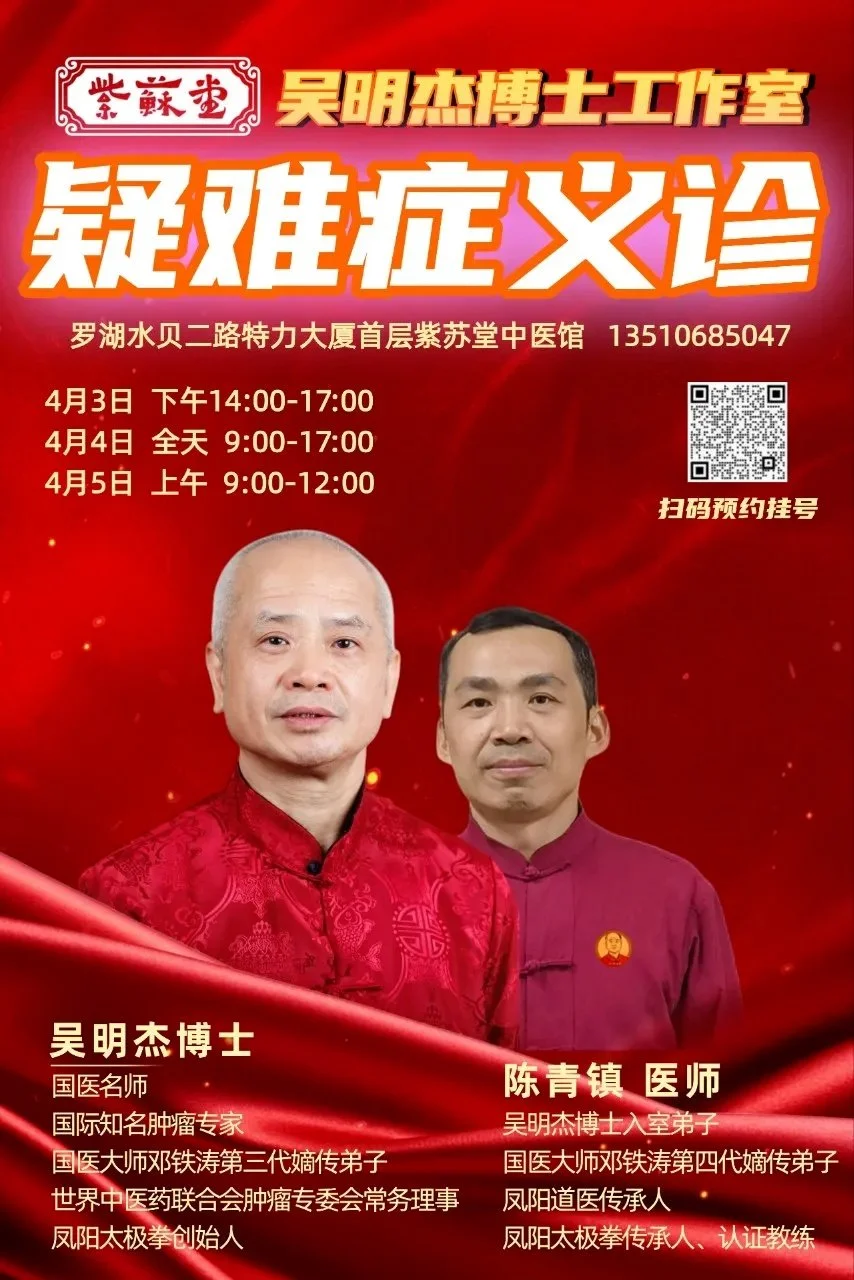
Good news! Dr. Wu Mingjie, a practitioner of Fengyang Taoist TCM, will hold a free clinic at Zisu Hall in Shenzhen from April 3 to April 5. For details, please see the image and scan the QR code to book your appointment~~~
Remember to share this with your friends and family!
Free Clinic Schedule:
April 3: Afternoon 14:00–17:00
April 4: All day 9:00–17:00
April 5: Morning 9:00–12:00
Zisu Hall Reservation Hotline: 13510686047
Address: Shenzhen Zisu Hall TCM Clinic (Te Li Building)