What Are the Fengyang Taiji Eight Forms?
When you hear "Taiji Quan," you probably picture slow-moving seniors in the park, or flashy competition routines.
The Fengyang Taiji Eight Forms are different from all of that.
They are not performance. They are not competition. They don't even try to "look good." They were born for one purpose—to help your specific, stressed, sedentary, screen-curved body find its balance again.
I. Origin: Three Decades Distilled
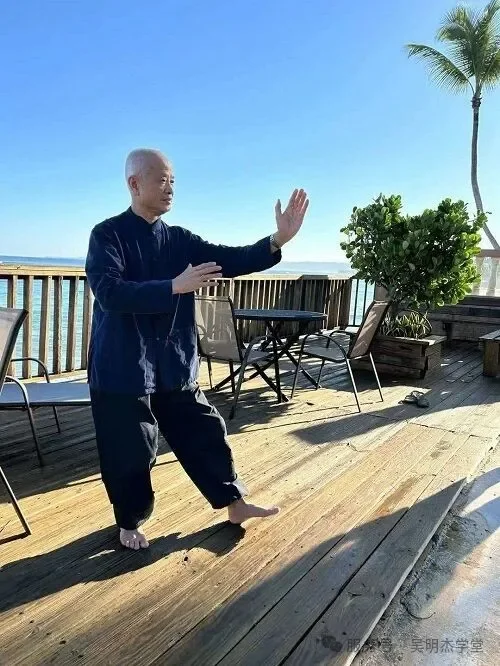
The creator of the Eight Forms, Dr. Wu Mingjie, has a uniquely integrated path:
- 🏥 TCM Heritage: Born into a Chaoshan medical family; 20th-generation inheritor of Fengyang Daoist Medicine
- 🥋 Taiji Lineage: Direct disciple of Master Zhu Zhenshun, 5th-generation Yang-style Taiji
- 🎓 Academic: PhD in TCM Philosophy; dissertation on Natural Therapies for Cancer Prevention
- 🇺🇸 Clinical Practice: Founded Wu Healing Center in Massachusetts, integrating Taiji, qigong, and TCM for chronic disease rehabilitation
After 40 years of clinical work and 30 years of Taiji practice, Dr. Wu identified a critical gap:
Traditional Taiji routines run 24, 42, even 88 forms. The elderly, the weak, and busy professionals simply cannot sustain them.
So he did something bold—he distilled the essence of traditional Taiji into eight core movements, each one targeting a critical energy pathway or rehabilitation goal.
The Fengyang Taiji Eight Forms were born.
II. The Eight Forms at a Glance
| # | Form Name | Core Action | Body System Targeted |
|---|---|---|---|
| 1 | Opening Posture (起势) | Relax body & mind; regulate breath; enter practice state | Autonomic nervous system |
| 2 | Wild Horse Parts Mane (野马分鬃) | Enhance coordination & balance; activate belt vessel & leg circulation | Core + lower-limb meridians |
| 3 | White Crane Spreads Wings (白鹤亮翅) | Expand chest; lift Yang; improve respiration | Heart/lung + upper-jiao Qi |
| 4 | Brush Knee & Twist Step (搂膝拗步) | Strengthen legs, waist & core; coordinate upper/lower body | Lumbosacral + lower-limb alignment |
| 5 | Play the Lute (手挥琵琶) | Cultivate balance, stability & concentration | Vestibular system + focus |
| 6 | Repulse Monkey (倒卷肱) | Increase spinal flexibility; improve backward stepping | Full-spine + proprioception |
| 7 | Seal & Close (如封似闭) | Cultivate internal power; unify inner & outer coordination | Dantian + whole-body integration |
| 8 | Closing Posture (收势) | Return mind to stillness; consolidate practice gains | Parasympathetic activation |
Core Principles
- 🌀 Dantian-Centered: Every movement originates from the Dantian
- 🌬️ Deep, Fine, Even, Long Breath: Natural coordination of movement and respiration
- 🪷 Relaxed but Not Slack; Sinking but Not Stiff: Natural relaxation with correct posture
- ⚙️ Waist as the Axis: The waist drives the four limbs, creating integrated power
- 🧠 Mind Guides Qi; Qi Moves the Body: The trinity of intention, breath, and movement become one
> "Methods are boundless; all paths return to the source. Taiji is precious because of the master who guides it; the cultivation depends entirely on one's own heart."> —Dr. Wu Mingjie
III. Why It "Addresses the Root of All Illness"
Fengyang Taiji doesn't "cure all diseases"—it treats the root from which many diseases sprout.
1. Regulate Qi & Blood, Open the Meridians
Coordinated movement and breathing activate the Governing Vessel, Conception Vessel, Belt Vessel, and Bladder Meridian. When Qi and Blood flow freely, the problem of "stagnation causing pain" dissolves naturally.
2. Release Fascia, Strengthen the Core
The spiral and extending movements precisely activate the deep core muscles—transverse abdominis, multifidus, quadratus lumborum—enhancing spinal stability.
This is like putting a > "natural lumbar support"> around your spine.
3. Breathing & Movement Unite, Calming the Spirit
The "movement within stillness" design, combined with abdominal breathing and Dantian concentration, directly regulates the autonomic nervous system—putting the brakes on sympathetic overdrive.
4. Raise Yang, Strengthen the Root
Long-term practice nourishes the kidneys, consolidates essence, raises Yang, and strengthens the body's self-healing capacity.
IV. Who Benefits Most?
| Group | Key Benefits |
|---|---|
| 🧓 Seniors | Better balance, fall prevention, reduced joint stiffness |
| 💼 Sedentary professionals | Posture correction, neck/shoulder release, low-back relief |
| 🏥 Post-op / chronic patients | Low-intensity, high-safety functional recovery |
| 😴 Insomnia & anxiety sufferers | Nervous system regulation, calming the heart-mind |
| 🧘 Meditation & wellness enthusiasts | Mind-body unity; "entering Chan through movement" |
The full routine takes > 3–15 minutes> —perfect for home, office, or community settings.
V. Integration at Wu Healing Center
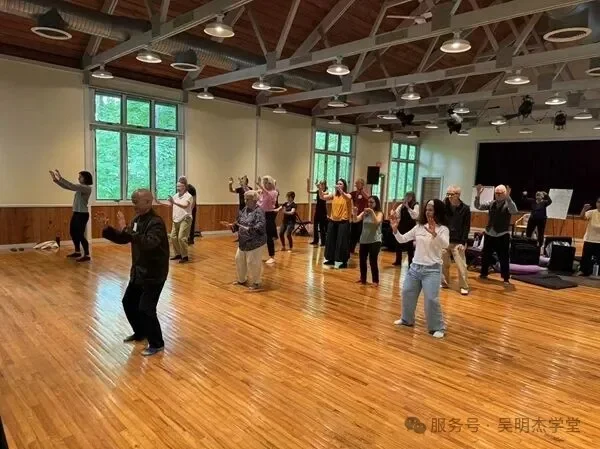
At Wu Healing Center, the Eight Forms are a core rehabilitation tool:
- 🩺 Physician Assessment: Personalized practice plans based on constitution & condition
- 🎓 Hands-On Instruction: Certified coaches correct form in real time
- 📈 Progress Tracking: HRV, pain scores, and functional assessments quantify improvement
- 🔄 Progressive Path: Eight Forms → 24 Forms → Taiji Stake → Microcosmic Orbit
VI. Important Cautions
⚠️ > Taiji may look gentle, but it is not "zero-risk."
Acute low-back pain, fractures, or severe osteoporosis: consult your physician first
Practice "to the point of comfort"—never force or strain
Learn under a qualified instructor to avoid ingraining poor movement patterns
Closing Thoughts
The Fengyang Taiji Eight Forms are the crystallization of Dr. Wu's 40 years of clinical experience and 30 years of Taiji cultivation.
It won't make you a Taiji master. Instead—
> It gives you 10 minutes a day to let your body return to balance.
In this fast-paced, high-pressure era, perhaps this is the simplest, safest, and most underrated health investment of all.
Related Reading
⚠️ > Disclaimer:> This article is for wellness education only. It does not constitute medical diagnosis or treatment advice. The Fengyang Taiji Eight Forms involve individual variability—please practice under professional guidance.
> The Fengyang Taiji Eight Forms are an exclusive IP created by Dr. Wu Mingjie. All rights reserved.
Produced by Wu Healing Center · Fengyang Daoist Medicine